This choice comes up constantly in industrial ventilation, dust collection, and pneumatic conveying design. The angle of a duct elbow directly affects airflow efficiency, pressure drop, component wear, and long-term operating costs. Neither option is universally better — the right call depends on your specific system constraints.
This article breaks down both elbow types, compares them side by side, and gives you a clear framework for selecting the right one.
Key Takeaways
- 45-degree elbows minimize turbulence and pressure drop, making them ideal for long runs and abrasive material conveying
- 90-degree elbows fit tight spaces with a compact footprint, but carry a higher pressure drop trade-off
- Selection depends on four factors: airflow velocity, material type, available space, and pressure requirements
- Both types are available in galvanized steel, stainless steel, and aluminum for different operating environments
45 Degree vs 90 Degree Elbow: Quick Comparison
| Feature | 45-Degree Elbow | 90-Degree Elbow |
|---|---|---|
| Angle of Turn | 45° | 90° |
| Flow Efficiency | Higher | Lower |
| Pressure Drop | Lower | Higher |
| Turbulence Level | Less | More |
| Space Required | More | Less |
| Typical Applications | Dust collection lines, long conveying runs | Compact equipment connections, directional changes |
| Wear on Duct Walls | Less, distributed | More, concentrated at bend |
| Installation Complexity | Easier in open runs | Easier in tight spaces |

Both elbow types are manufactured to SMACNA industrial duct construction standards and are available in galvanized steel, stainless steel (304/316), and aluminum for industrial, food-grade, and corrosive environments.
What Is a 45 Degree Elbow?
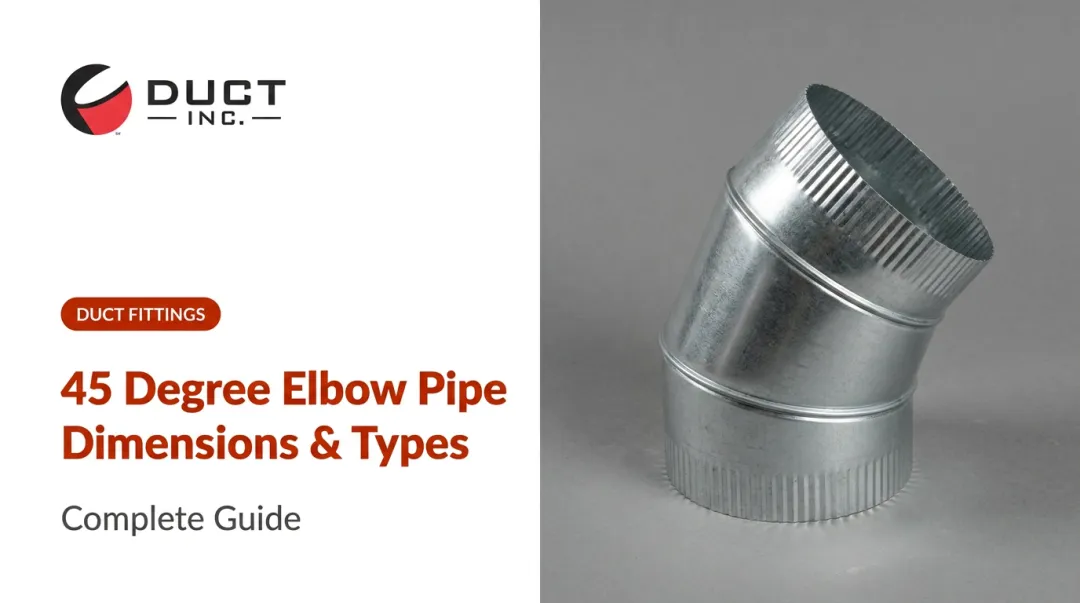
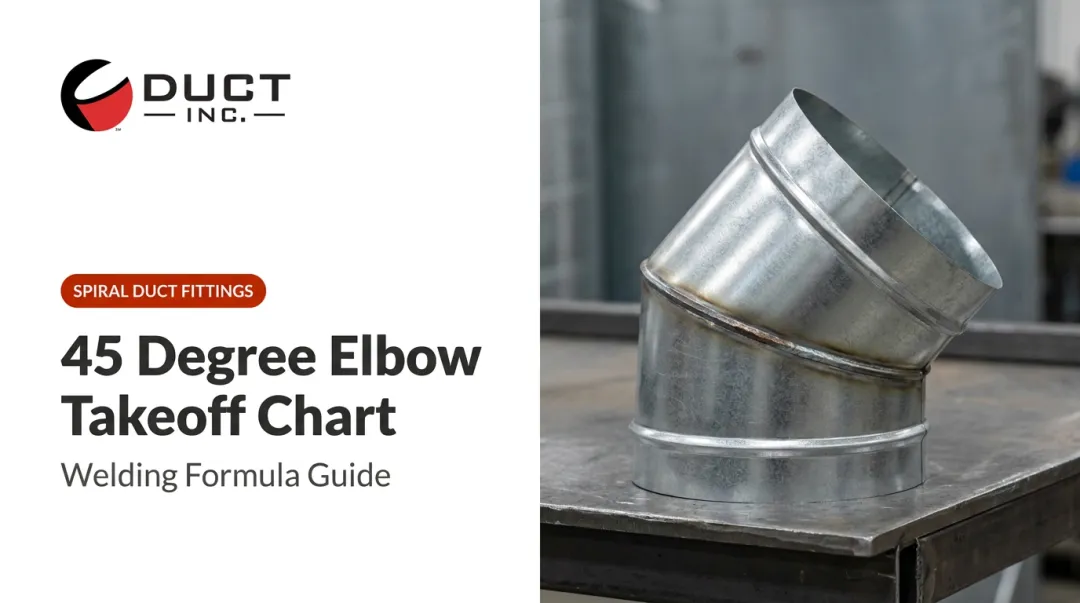
A 45-degree elbow is a duct fitting that redirects airflow or conveyed material at a 45-degree angle — a gradual directional change compared to a right-angle bend. That shallower arc keeps flow velocity more consistent through the turn, reducing pressure drop and lowering the load on the system fan.
Flow and Pressure Performance
The performance advantage is backed by published data. According to ASHRAE's Fitting Loss Coefficients reference, the angle correction factor for a 45-degree round smooth elbow is 0.60, compared to 1.00 for a 90-degree elbow. The ACGIH Industrial Ventilation Manual simplifies this further: a 45-degree elbow produces half the pressure loss of an equivalent 90-degree elbow.
In practical terms, the Loren Cook Engineering Cookbook puts 45-degree round duct elbows at 15–20 ft equivalent length (depending on construction). Common 90-degree configurations range from 17 to 61 ft, depending on piece count and radius ratio — meaning the resistance difference can be substantial in multi-elbow systems.
Wear Distribution in Abrasive Systems
The gradual bend also distributes particle impact over a larger surface area. When conveying abrasive bulk materials — grain, coal, cement, mineral dust — air and particles hit the duct wall at a shallower angle, reducing concentrated wear. Research published in Powder Technology confirms that increasing the radius of curvature reduces particle impact intensity, which extends elbow service life in high-velocity conveying applications.
The Space Tradeoff
Those performance advantages come with a layout cost: footprint. Executing a 45-degree directional change requires more linear space than a sharp 90-degree turn. In tight mechanical rooms or dense duct layouts, that extra run length may not be available.
Use Cases for 45-Degree Elbows
- Industrial ventilation lines with long distribution runs
- Pneumatic conveying systems handling abrasive bulk solids (grain, minerals, plastics)
- Agricultural processing plants and grain handling facilities
- Chemical processing exhausts where flow consistency is critical
- Manufacturing facilities with open duct routing and energy efficiency targets
What Is a 90 Degree Elbow?
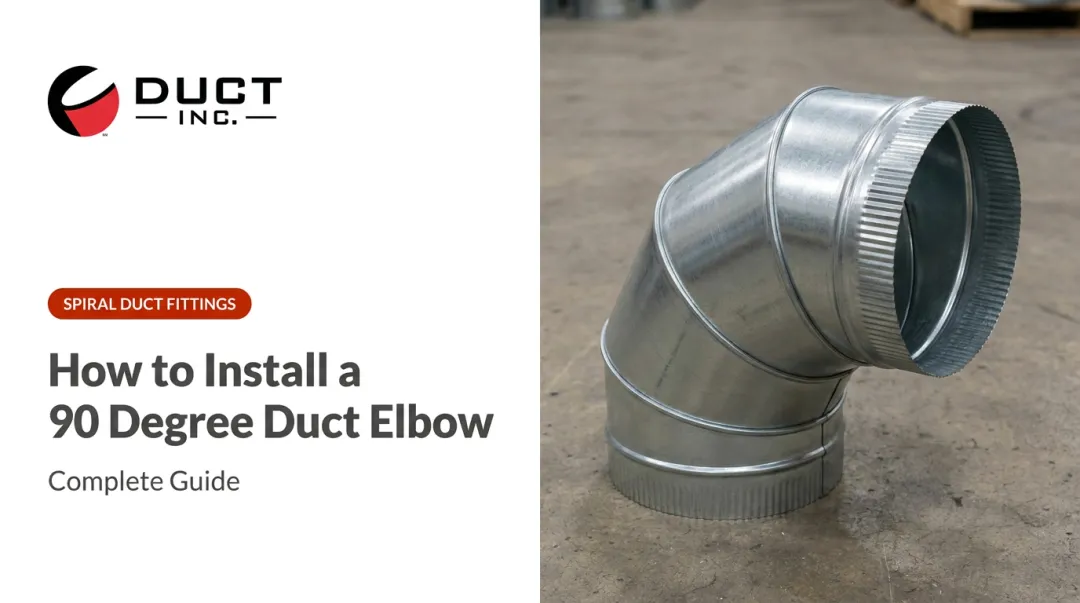
A 90-degree elbow — also called a quarter bend — redirects airflow at a right angle. It's the standard choice when space is the binding constraint and the system can tolerate higher pressure losses.
Compact Layout Advantage
The 90-degree turn fits within a much smaller footprint than any gradual-arc alternative. This makes it the go-to fitting for dense duct layouts in building mechanical rooms, ceiling plenums, or industrial enclosures where routes must navigate columns, beams, and structural obstructions. Standard 90-degree round elbows use 5-piece construction with a centerline radius of at least 1.5 times the inside duct diameter, keeping the fitting compact without extreme pressure penalties.
Pressure Drop and Energy Tradeoff
That compact geometry carries a pressure penalty. ASHRAE lists 90-degree round smooth-elbow loss coefficients ranging from 0.12 at r/D 2.5 to 0.71 at r/D 0.5, with the 90-degree angle factor set as the baseline at 1.00. Equivalent lengths for 90-degree configurations span 17 to 136 ft depending on construction type and radius ratio, compared to 15–20 ft for 45-degree elbows.
The fan must generate more static pressure to overcome that resistance, raising operating costs across the system's service life. The DOE/AMCA Improving Fan System Performance sourcebook puts this in context: fans in US manufacturing consume 78.7 billion kWh per year, and poor duct configurations can cut delivered flow by up to 30% while increasing power draw.

Wear Concentration
At high velocities, heavier particles concentrate impact at the bend point of a 90-degree elbow rather than distributing it across a larger surface. In demanding conveying applications, this accelerates localized wear and may require periodic inspection or higher-grade materials.
Use Cases for 90-Degree Elbows
- Commercial and industrial HVAC systems with tight routing constraints
- Building mechanical rooms, chases, and ceiling plenums
- Industrial plants routing ducts around structural elements
- Compact pneumatic conveying systems handling lighter, non-abrasive materials
- Industrial drainage and exhaust systems where space is the primary constraint
Which Elbow Is Better for Your System?
Neither elbow is universally superior. The right choice comes from weighing four variables against each other: flow velocity, material type, available space, and pressure budget.
Choose a 45-Degree Elbow When:
- Flow efficiency is the priority — long duct runs or high-velocity systems where pressure losses compound across multiple fittings
- The system conveys abrasive or fragile materials (grain, minerals, plastics) where concentrated impact wear shortens elbow life
- Energy costs over the system's lifetime matter more than the larger spatial footprint
- Open routing is available in the facility layout
Choose a 90-Degree Elbow When:
- Installation space is constrained and routing around structural elements is necessary
- The system handles lighter, non-abrasive air streams where concentrated wear is not a concern
- The calculated pressure drop stays within acceptable limits for the fan or blower selection
- Compact duct layout is a higher priority than optimizing energy consumption
A Note on Two 45-Degree Elbows vs. One 90-Degree Elbow
A common workaround is combining two 45-degree elbows to achieve a 90-degree change in direction with lower pressure loss. Whether this actually reduces losses depends on the specific elbow construction and radius ratio. Using the Loren Cook equivalent-length data as a reference: two 45-degree 3-piece elbows total 30 ft equivalent length, which is less than a 90-degree 5-piece elbow at 39–61 ft. However, two 2-piece 45-degree elbows total 40 ft — which matches or exceeds some 90-degree options. The result is configuration-dependent, not universal.
Sourcing the Right Configuration
For industrial ductwork applications, the quality of the elbow matters as much as the angle. Duct Incorporated manufactures spiral duct elbows in both 45-degree and 90-degree configurations, available in galvanized steel, galvaneal, stainless steel 304/316, and aluminum — covering dust collection, material handling, and industrial ventilation across grain handling, cement processing, and mining applications.

Elbows ship factory-direct across the US, with custom fabrication available for non-standard sizes and configurations. Browse configurations at ductincorporated.com/elbows/ or request a quote directly.
Conclusion
Choosing between a 45-degree and 90-degree elbow comes down to a direct tradeoff: the 45-degree elbow delivers lower pressure drop, better wear distribution, and stronger long-term energy performance. The 90-degree elbow trades those gains for compactness and easier routing where space is tight.
For any industrial or commercial duct system, the right selection directly affects energy costs, maintenance frequency, component lifespan, and overall system reliability. Run the numbers using ASHRAE loss coefficients or equivalent-length methods specific to your configuration. For abrasive materials or high-velocity conveying, factor in wear mechanisms alongside pressure performance — both matter for total cost of ownership.
If you're sourcing elbows for dust collection, material handling, or industrial ventilation, Duct Incorporated supplies 45-degree and 90-degree spiral duct elbows factory-direct in galvanized, stainless, and aluminum — from 3" up to 80"+ diameter. Reach out with your system specs and get the right fitting the first time.
Frequently Asked Questions
What is a 45-degree elbow?
A 45-degree elbow is a duct or pipe fitting that redirects the flow of air, gas, or bulk material at a 45-degree angle. The gradual directional change reduces turbulence and pressure loss compared to sharper bends, making it the preferred choice for long distribution runs and abrasive conveying systems.
What is the difference between a 45-degree elbow and a 90-degree elbow?
The core differences are angle of turn (45° vs. 90°), pressure drop (lower vs. higher), and space requirements (more linear space vs. compact footprint). The 45-degree elbow is preferred for long runs and abrasive conveying; the 90-degree suits tight spaces where the pressure loss is acceptable.
What is the difference between a 45-degree elbow and a 45-degree street elbow?
Both redirect flow at 45 degrees, but a street elbow has one male end and one female end, which allows direct connection between fittings without a short pipe nipple. A standard elbow has two female ends and requires a nipple or pipe stub to join consecutive fittings.
Can you use two 45-degree elbows instead of one 90-degree elbow?
Yes, and in many configurations this reduces pressure loss. Two 45-degree 3-piece round elbows equal approximately 30 ft equivalent length versus 39–61 ft for a 90-degree 5-piece elbow — though results vary by elbow construction and radius ratio, so verify with project-specific coefficients.
Which elbow is better for HVAC duct systems?
For long HVAC distribution runs, 45-degree elbows generally perform better by reducing pressure drop and fan energy. In tight mechanical rooms or building chases where routing flexibility is limited, 90-degree elbows are the standard choice despite the higher flow resistance.
What materials are duct elbows commonly made from?
The most common materials are galvanized steel (standard for general HVAC and dust collection), stainless steel 304/316 (for corrosive or high-temperature environments), and aluminum (for lightweight or moisture-prone applications). The right choice depends on what the system conveys, operating temperatures, and how long the installation needs to last without maintenance.