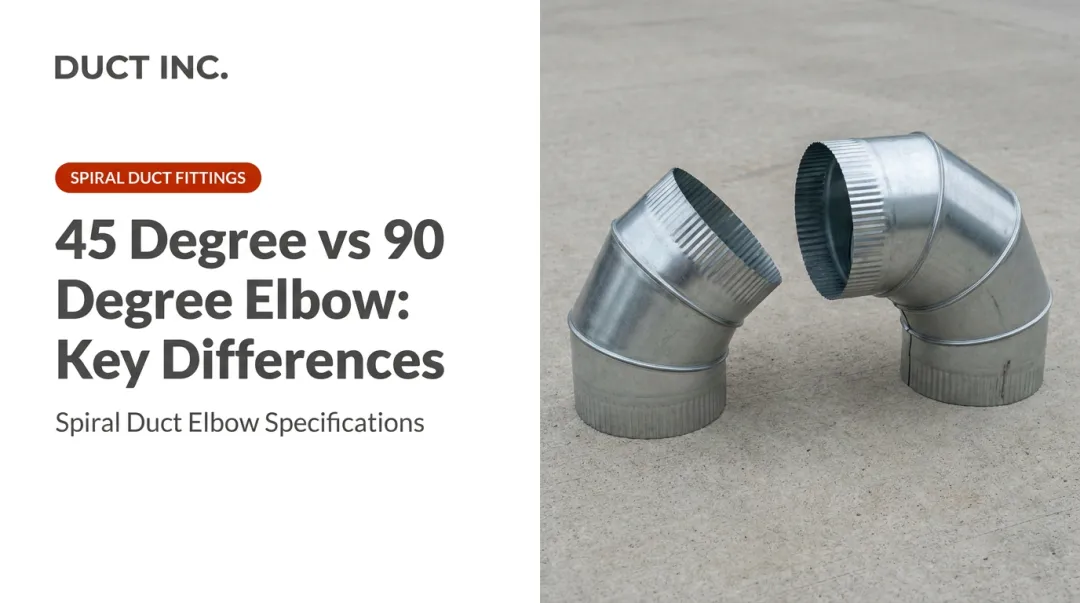
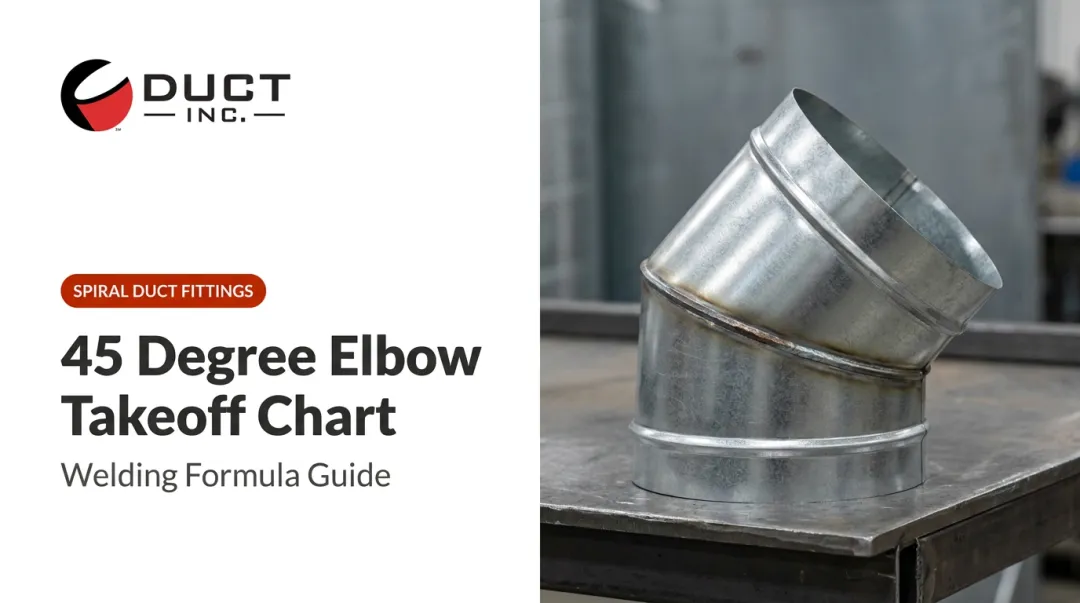
This guide covers what a 45-degree elbow is, how to read its key dimensions per ASME B16.9, the three main radius types and when to use each, and how to avoid the selection mistakes that cause problems during fabrication and commissioning.
Key Takeaways
- 45-degree elbows redirect flow at a 45° angle; butt-weld fittings follow ASME B16.9 (NPS ½ to NPS 48)
- Center-to-end dimension "B" governs layout — distinct from dimension "A" used on 90-degree elbows
- Three radius types exist: Long Radius (1.5D), Short Radius (1.0D), and 3D — each with different space and flow trade-offs
- LR is the standard default; SR conserves space but raises pressure drop; 3D is preferred for sensitive or abrasive services
- Dimensional tolerances (±2 mm for NPS ½–24) directly affect spool fabrication fit-up — ignoring them causes assembly failures
What Is a 45 Degree Pipe Elbow?
A 45-degree pipe elbow is a curved fitting that redirects flow at a 45-degree angle. Compared to a 90-degree elbow, it produces a gentler directional change — less turbulence, lower pressure loss, and a smoother transition for the fluid or air being conveyed.
These fittings appear across industrial piping, HVAC, dust collection, and material handling systems — anywhere a pipe run needs to offset around a structural obstacle without a full right-angle turn.
For pressure piping applications, 45-degree butt-weld elbows are factory-made wrought fittings governed by ASME B16.9, which covers sizes from NPS ½ through NPS 48. That standard defines:
- Overall dimensions and tolerances for each nominal pipe size
- Pressure ratings tied to material and wall thickness
- Testing requirements and acceptable inspection methods
- Marking requirements for traceability and specification compliance
Sheet-metal and spiral duct elbows — used in dust collection, ventilation, and material handling — follow a separate framework under SMACNA standards rather than ASME B16.9, with dimensions driven by duct diameter and radius-to-diameter ratio instead of nominal pipe schedules.
Key Dimensions of a 45 Degree Elbow Explained
The Three Core Parameters
Every 45-degree elbow is defined by three dimensional parameters:
- Nominal Pipe Size (NPS) — the reference size designation (not the actual pipe OD)
- Outside Diameter at Bevel (OD) — the actual pipe outside diameter in millimeters
- Center-to-end "B" — the distance from the theoretical centerline intersection to each pipe end opening
That last one — dimension B — is the number piping designers work with most. It's what distinguishes a 45-degree elbow dimensionally from a 90-degree elbow (which uses dimension "A"). Get B wrong on a spool drawing, and the pipe won't reach the next flange.
ASME B16.9 LR 45° Elbow Dimensions
The table below shows verified dimensions from ASME B16.9-2024, Table 6.1-1, cross-checked against the Weldbend manufacturer catalog:
| NPS | OD (mm) | Center-to-End B (mm) |
|---|---|---|
| ½ | 21.3 | 16 |
| 1 | 33.4 | 22 |
| 2 | 60.3 | 35 |
| 4 | 114.3 | 64 |
| 6 | 168.3 | 95 |
| 8 | 219.1 | 127 |
| 10 | 273.0 | 159 |
| 12 | 323.8 | 190 |
For the complete NPS ½ to NPS 48 table, refer directly to ASME B16.9-2024. Do not interpolate intermediate values from the formula alone — ASME tabulates rounded standard dimensions that won't always match a formula calculation exactly.
Bend Radius Formulas
The bend radius depends on which radius type you're specifying:
- Long Radius (LR): Bend radius = 1.5 × NPS (inches)
- Short Radius (SR): Bend radius = 1.0 × NPS (inches)
- 3D: Bend radius = 3.0 × NPS (inches)
Worked example for NPS 4:
- LR bend radius = 1.5 × 4 = 6 inches (152 mm)
- SR bend radius = 1.0 × 4 = 4 inches (102 mm)
- 3D bend radius = 3.0 × 4 = 12 inches (305 mm)

Finding the Center of a 45-Degree Elbow
The "center" is the theoretical intersection point of the two pipe centerlines extended through the fitting. Dimension B gives the distance from that intersection to each pipe end opening. This is what isometric drawing software uses to position the fitting in a spool layout — it's a layout dimension, not a physical mark you'll find on the fitting itself.
Dimensional Tolerances Per ASME B16.9
These tolerances apply per ASME B16.9 during spool fabrication:
- Center-to-end (NPS ½–24): ±2 mm
- 3D elbows (NPS ½–24): ±3 mm; NPS 26–48: ±6 mm
- Wall thickness: Not less than 87.5% of marked nominal thickness
A ±2 mm tolerance sounds small, but across multiple fittings in a long spool run, accumulated tolerance stack-up can cause flanges to miss their bolt circles by enough to require field cutting and rewelding.
Types of 45 Degree Pipe Elbows
The three radius types differ in bend geometry, which directly affects pressure drop, space requirements, and suitability for specific services. Choosing by habit rather than by system requirements is where most selection errors originate.
Long Radius (LR) 45 Degree Elbow
The LR elbow has a bend radius of 1.5 times the nominal pipe diameter. That larger sweep produces a gradual directional change, which keeps turbulence low and pressure loss manageable. It's the standard ASME B16.9 butt-weld fitting and the default choice for most piping systems.
Best suited for:
- General process piping with adequate layout space
- Industrial ventilation and dust collection systems
- Applications where minimizing pressure drop is a design priority
Trade-off: The longer arc takes up more physical space. In compact equipment rooms, modular skids, or retrofit work where every inch counts, fitting an LR elbow may simply not be possible.
Short Radius (SR) 45 Degree Elbow
The SR elbow cuts the bend radius to 1.0 times the nominal diameter, producing a tighter arc that reduces the fitting's physical footprint. It's less commonly stocked as a standard catalog item and may require special ordering in some sizes.
Best suited for:
- Congested piping layouts and equipment tie-ins
- Marine, offshore, and machinery-room installations
- Situations where routing constraints make the tighter radius unavoidable
Trade-offs: The sharper curve increases turbulence and pressure drop compared to an LR elbow. In high-velocity or abrasive flow services, the inside radius of an SR elbow is also more susceptible to erosion — research on elbow erosion behavior confirms that smaller curvature radii concentrate wear at the bend intrados, particularly with particulate-laden flows.
Use SR elbows when space forces the decision. Don't use them as a cost-saving shortcut.
3D 45 Degree Elbow
The 3D elbow extends the bend radius to three times the nominal diameter, the gentlest directional change of the three types. The longer arc reduces turbulence and mechanical stress on the fitting wall.
Best suited for:
- Abrasive slurry transport and high-velocity particulate conveying
- High-purity piping in pharmaceutical and food processing environments
- Cryogenic systems and high-pressure long-distance pipelines
- Applications requiring minimal flow disturbance upstream of instrumentation
Trade-offs: 3D elbows require considerably more installation space than either LR or SR type. Many sizes aren't available from standard stock and require fabrication to order. Factor lead time and cost into project planning when specifying them.

How to Choose the Right 45 Degree Elbow
The Decision Logic
Selection comes down to four variables: available installation space, allowable pressure drop, the type of media being conveyed, and the applicable project specification or standard.
A straightforward decision framework:
- Space is constrained → SR (accept the higher pressure drop; calculate it first)
- Flow quality or abrasion resistance is critical → 3D (accept the larger footprint and cost)
- All other cases → LR (best balance of performance and availability)
Material and End-Connection Matching
The fitting material must match the pipe specification and service conditions:
| Service | Material Standard | Common Grade |
|---|---|---|
| Carbon steel, moderate/high temp | ASTM A234/A234M | WPB |
| Austenitic stainless steel | ASTM A403/A403M | WP316, WP304 |
| Low-pressure, corrosive | PVC or HDPE | Schedule 40 / ASTM F714 |
End connections for butt-weld fittings must match the pipe's bevel preparation. Socket-weld and threaded end connections are covered under separate standards (ASME B16.11) and are generally limited to NPS 4 and below.
Industrial Ductwork Considerations
For industrial duct applications — dust collection, material handling, process ventilation — radius selection also affects airflow efficiency and system energy consumption. The ACGIH Industrial Ventilation manual recommends a centerline radius of at least 2.0D, preferably 2.5D, to minimize resistance in industrial exhaust duct elbows.
For projects where those radius requirements apply, Duct Incorporated manufactures industrial ductwork elbows across dust collection, pneumatic conveying, fume extraction, and material handling applications. Their elbow line is available in galvanized, stainless steel 304/316, aluminum, and galvaneal — with custom fabrication options for non-standard radius configurations or sizes outside typical stock ranges.
Common Mistakes to Avoid
Three mistakes show up repeatedly in elbow specification — each avoidable with a bit of upfront discipline:
1. Defaulting to SR elbows to save space without calculating pressure drop. SR elbows do take up less room, but in high-velocity or abrasive services they erode prematurely. The unplanned maintenance costs that follow typically exceed whatever was saved at procurement.
2. Ignoring dimensional tolerances during spool fabrication. As noted in pipe fabrication guidance from Wermac, failure to account for manufacturing tolerances can impose unintended mechanical stress and invalidate design assumptions.
For a 12-fitting spool with ±2 mm tolerance on each center-to-end dimension, cumulative error can reach ±24 mm — enough to cause serious fit-up problems at flanged connections.
3. Specifying by availability rather than by system fit. Two examples worth flagging:
- Using an LR elbow when a flow meter upstream requires a longer straight run for accurate measurement — check ISO 5167-2 straight-run requirements for orifice metering applications
- Specifying carbon steel in a corrosive service because it's on the shelf, when the fluid chemistry demands stainless or alloy steel

Each of these mistakes is a procurement shortcut that creates an engineering problem downstream.
Frequently Asked Questions
What are the dimensions of a 45 degree elbow?
The key dimensions are diameter, centerline radius, and center-to-end length (dimension "B"). For a Long Radius 45° duct elbow at 4" diameter, center-to-end B = approximately 64 mm. Full dimensional tables by diameter are available from the relevant standard for your fitting type (pressure pipe: ASME B16.9; spiral duct: manufacturer specs).
How do you calculate the bend radius of a 45 degree elbow?
Bend radius = radius multiplier × NPS (in inches): LR = 1.5 × NPS, SR = 1.0 × NPS, 3D = 3.0 × NPS. For an NPS 6 LR elbow, bend radius = 1.5 × 6 = 9 inches (229 mm).
How do you find the center of a 45 degree elbow?
The center is where the two pipe or duct centerlines would intersect if extended through the fitting. Dimension B gives the distance from that point to each pipe end, which designers use when laying out pipe spools or duct runs.
What is the difference between a 45 degree and a 90 degree elbow?
A 45-degree elbow changes direction by 45°, producing less turbulence and pressure drop than a 90-degree elbow. Dimensionally, the 90-degree elbow uses center-to-end dimension "A," while the 45-degree uses dimension "B." Use a 45-degree where a gradual offset is needed rather than a full right-angle turn.
What materials are 45 degree pipe elbows available in?
Common options for industrial duct elbows include galvanized steel, galvaneal, stainless steel (304 or 316), and aluminum. For pressure piping, carbon steel and alloy steel are standard. Choose based on your service environment — stainless for corrosive or high-temperature applications, galvanized for general-purpose dust collection and ventilation.
What does "long radius" mean for a 45 degree elbow?
Long Radius means the centerline bend radius equals 1.5 times the nominal pipe diameter. For a 45° LR elbow, this produces a gradual curve that minimizes flow turbulence and pressure drop — which is why it's the most widely specified type in standard industrial piping and ductwork systems.