For industrial buyers and contractors, this decision touches every dimension of a project: upfront cost, corrosion resistance, temperature tolerance, and long-term maintenance. A mismatch between material and environment doesn't just shorten equipment life — it creates safety risks, compliance gaps, and unplanned downtime.
This guide breaks down exactly how these two materials differ, where each performs best, and how to match the right specification to your actual operating conditions.
Key Takeaways
- Galvanized steel relies on a zinc coating for corrosion protection; stainless steel resists corrosion through its chromium alloy composition — no coating required
- Galvanized steel costs less upfront but carries a finite service life in humid, corrosive, or chemically aggressive environments
- Stainless steel handles continuous temperatures up to 925°C vs. galvanized steel's 200°C (392°F) ceiling
- The right choice depends on environment, chemical exposure, operating temperature, and required service life
- For ductwork in dust collection or material handling, matching material to process conditions prevents premature failure and replacement costs
Galvanized Steel vs. Stainless Steel: Quick Comparison
| Attribute | Galvanized Steel | 304 Stainless Steel | 316 Stainless Steel |
|---|---|---|---|
| Cost | Lower upfront cost | Significantly higher | Highest (adds molybdenum) |
| Composition | Plain carbon steel + zinc coating (hot-dip process) | ≥10.5% chromium iron alloy | 10.5%+ chromium + molybdenum |
| Corrosion Resistance | Sacrificial zinc coating — finite protection | Self-healing chromium oxide layer | Superior — resists chlorides and acids |
| Yield / Tensile Strength | ASTM A653: 33–80 ksi yield / 45–90 ksi tensile | 31.2 ksi yield / 73.2 ksi tensile | 34.8 ksi yield / 79.8 ksi tensile |
| Continuous Temp. Limit | 392°F / 200°C max recommended | Up to 925°C in dry air | Up to 925°C in dry air |
Sources: MatWeb: 304 Stainless Steel mechanical properties, MatWeb: 316 Stainless Steel mechanical properties, AGA: Hot-Dip Galvanized Steel temperature performance

Key takeaway: Temperature and corrosion exposure are the clearest technical separators between these materials. Strength varies by specification and grade.
What Is Galvanized Steel?
Galvanized steel is plain carbon steel coated with zinc through hot-dip galvanizing — immersing the steel in molten zinc to create a layered zinc-iron alloy coating. The result is a material that delivers far better corrosion resistance than bare steel at a fraction of the cost of alloyed alternatives.
How the Zinc Coating Works
The zinc layer protects the base steel through sacrificial corrosion: zinc oxidizes preferentially, corroding before the steel underneath. This means minor surface scratches don't immediately compromise protection — the zinc around the damaged area continues to shield the base metal. Once the coating is fully depleted, however, the base steel is exposed and rusts quickly.
According to the American Galvanizers Association, zinc corrodes at approximately 0.6–5.9 mils/year in pure water; seawater accelerates this to 0.5–1.0 mil/year in temperate seas. In saltwater splash or tidal zones, the time to first maintenance drops to just 2–3 years. Zinc also degrades rapidly below pH 4 or above pH 12 — critical for facilities handling acidic or alkaline process exhaust.
Welding galvanized steel produces zinc oxide fumes, which OSHA identifies as the primary cause of metal fume fever. This rules out galvanized steel in food environments or occupied spaces without proper ventilation controls.
Types of Galvanized Steel
| Type | Coating | Best For |
|---|---|---|
| Hot-dip galvanized | Thickest zinc coating | General industrial ductwork, structural applications |
| Electrogalvanized | Thinner, smoother finish | Precision parts, pre-painted applications |
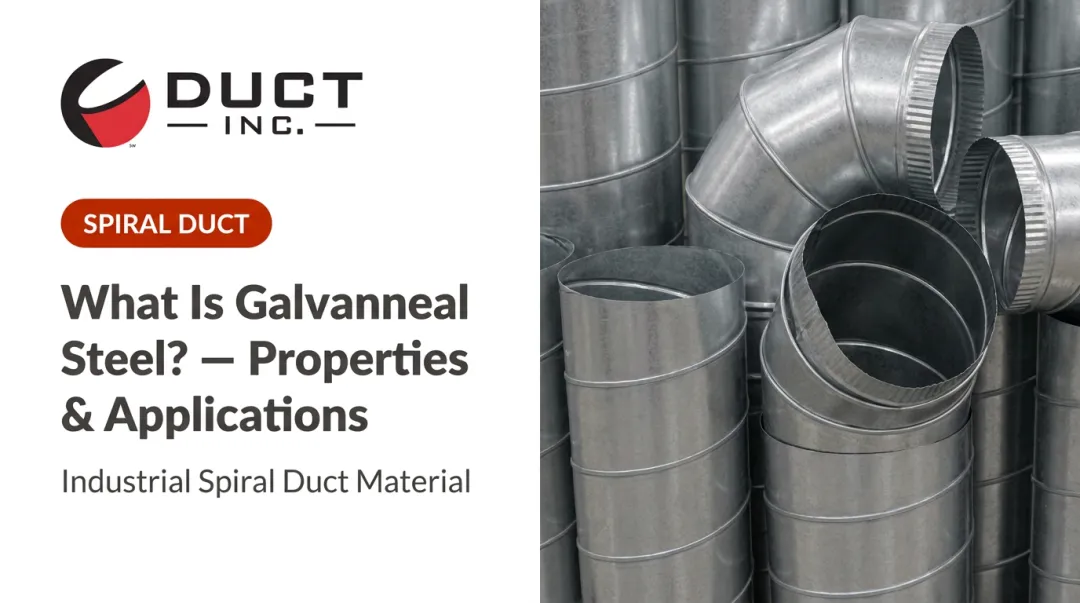
| Galvannealed | Zinc-iron alloy finish | Applications requiring welding or surface painting |
Hot-dip is the dominant choice for industrial ductwork. Duct Incorporated offers both galvanized (hot-dip) and galvaneal variants as distinct material selections across their spiral duct pipe product line.
Where Galvanized Steel Fits
Galvanized steel is the standard material for commercial HVAC ductwork, structural framing, highway guardrails, and general industrial ventilation — wherever cost efficiency and moderate corrosion resistance take priority over extreme durability. It dominates in construction, automotive, agriculture, general manufacturing, and infrastructure serving dry or mild inland climates.
Duct Incorporated supplies galvanized spiral duct as the default choice for general commercial and industrial applications — dust collection, material handling, and pneumatic conveying — available in diameters from 3" to 80"+ with gauges from 24-gauge (3") to 20-gauge (14"–16").
What Is Stainless Steel?
Stainless steel is a group of iron-based alloys containing a minimum of 10.5% chromium. That chromium reacts with oxygen to form a passive chromium oxide layer on the surface — an invisible, self-healing barrier that prevents rust from forming. Unlike galvanized steel's applied coating, this protection is intrinsic to the material itself.
304 vs. 316: Choosing the Right Grade
| Grade | Composition | Best Environment |
|---|---|---|
| 304 | Fe + ≥10.5% Cr + Ni | General industrial, low-chloride environments |
| 316 | 304 + molybdenum | Coastal, saltwater, acidic chemical processing |
304 stainless handles most corrosive environments well but can be compromised by high chloride concentrations. 316 stainless adds molybdenum, which improves resistance to chlorides, acids, and aggressive chemical exposure — making it the preferred grade for coastal construction, food processing, and chemical fume extraction.

Grade selection isn't the only spec consideration when working with stainless. Mixed-metal assemblies introduce a separate risk: when stainless steel and galvanized components make electrical contact in the presence of moisture, galvanic corrosion occurs. Zinc corrodes sacrificially, accelerating coating failure at every contact point. Isolate or avoid mixed-metal contact in wet service environments.
Strength and Temperature Advantages
Stainless steel's performance edge over galvanized is clearest in two dimensions:
- Temperature: 304 and 316 stainless handle continuous service up to 1,697°F (925°C) in dry air. Galvanized coatings begin degrading above 392°F (200°C) and are not recommended above 480°F (250°C).
- Tensile strength: Annealed 304 reaches 73.2 ksi; 316 reaches 79.8 ksi. Most standard galvanized grades fall well below HSLA highs, putting stainless in a comparable or stronger range for typical structural applications.
Limitations Worth Noting
- Higher upfront material and fabrication cost
- Galling risk when two stainless surfaces are in friction contact
- Can be over-specified for standard indoor, low-humidity environments where galvanized performs adequately
Where Stainless Steel Fits
Stainless steel is required for industrial kitchen exhaust, chemical processing plants, pharmaceutical manufacturing, food and beverage facilities, marine construction, and any high-temperature industrial exhaust system.
The 2015 International Mechanical Code (IMC) makes this explicit: Type I commercial kitchen grease ducts must use No. 16 steel or No. 18 stainless steel — standard galvanized duct does not meet this requirement.
Duct Incorporated supplies both 304 and 316 stainless spiral duct in diameters from 3" to 80"+, allowing specification of the exact grade needed for your application's corrosion demands.
Galvanized Steel vs. Stainless Steel: Which Should You Choose?
The right material comes down to five variables: environment, chemical or fume exposure, required service life, operating temperature, and budget. Getting this wrong in an industrial setting shortens equipment life, creates compliance gaps, and drives unplanned maintenance costs.
Decision Guide by Condition
Choose galvanized steel when:
- Indoor or above-grade installation in dry or mild climates
- Operating temperatures stay below 392°F (200°C) continuously
- Budget constraints are a primary driver
- Environment is controlled with no aggressive chemical exposure
- General commercial HVAC or dust collection in non-corrosive settings
Choose stainless steel when:
- Coastal, high-humidity, or saltwater-adjacent installation
- Chemical fume, acidic, or alkaline exhaust exposure
- Continuous operating temperatures exceed 392°F
- Food-grade, pharmaceutical, or hygienic environment requirements apply
- System must perform for 20+ years without significant maintenance

Ductwork-Specific Temperature Limits
Temperature is a hard line for galvanized ductwork. The American Galvanizers Association sets the recommended long-term continuous maximum at 392°F / 200°C, with exposure above 480°F not recommended. That rules out galvanized steel for industrial exhaust systems, commercial kitchen hoods, and process fume extraction where exhaust temperatures regularly exceed that threshold.
Stainless steel — both 304 and 316 — handles continuous service well beyond these limits, making it the required specification for high-temperature ductwork applications.
Real-World Application: When Material Selection Goes Wrong
A 2022 analysis of hazardous exhaust ductwork by BHDP/American Laboratory illustrates the failure pattern clearly: plastic-coated galvanized steel used in chemical exhaust applications is subject to corrosion at cut edges and cannot be field-welded without exposing base metal. When the protective coating fails — through chemical dissolution or heat — base steel corrosion begins immediately, requiring full system replacement rather than simple repair.
The lesson applies directly to galvanized duct in aggressive environments: the coating is the only protection. In corrosive or high-temperature conditions, that protection degrades faster than expected — and repair isn't an option when base metal is exposed.
If your application involves moisture, chemicals, elevated temperatures, or strict hygiene standards, stainless steel's higher upfront cost is routinely offset by longer service life and avoided replacement cycles. Duct Incorporated can help you specify the right material — galvanized, 304, or 316 stainless — for your ductwork requirements. Contact Duct Incorporated to discuss your application.
Conclusion
Galvanized steel is a proven, cost-effective choice for standard environments where moderate corrosion resistance is sufficient. Stainless steel is the right investment when the application demands durability, chemical resistance, temperature performance, or long-term reliability without frequent maintenance cycles.
The application defines the correct specification.
For industrial buyers, the upfront cost difference is only part of the equation. Early system failure, unplanned shutdowns, and compliance gaps carry their own price tag — often a steeper one. Choose based on your actual operating conditions and what the system needs to survive over its full service life.
Frequently Asked Questions
Is hot-dipped galvanized good for outdoor use?
Hot-dip galvanized steel performs well in most above-grade outdoor environments in dry or inland climates. Coastal, marine, or high-humidity locations accelerate zinc coating breakdown — stainless steel is the right choice in those conditions.
How long does hot-dipped galvanized steel last?
Lifespan depends heavily on the environment. In industrial atmospheric conditions, structural steel with a 3.9 mil zinc coating can achieve 72–73 years to first maintenance. In coastal or seawater-exposed environments, that drops to 8–12 years — and just 2–3 years in splash or tidal zones.
When should you not use galvanized steel?
Avoid galvanized steel in these conditions:
- Saltwater, coastal, or marine environments
- Acidic conditions below pH 4 or alkaline above pH 12
- Continuous high-temperature applications exceeding 392°F
- Food-grade settings where zinc contamination is a risk
- Direct contact with stainless steel components in the presence of moisture (galvanic corrosion)
Which steel is better for HVAC and industrial ductwork?
Galvanized steel is standard for most commercial HVAC ductwork in controlled indoor environments. Stainless steel is required for industrial exhaust, commercial kitchen hoods, chemical fume extraction, and any ductwork exposed to moisture, corrosive gases, or temperatures above 392°F.
Is stainless steel significantly more expensive than galvanized steel?
Stainless steel carries a higher upfront material cost than galvanized steel. In demanding applications — coastal environments, food processing, chemical fume extraction — the longer service life and lower replacement frequency typically justify the premium on a total cost basis.