A blast gate solves this. It's a mechanical valve inserted into a duct branch that lets you fully open or close airflow to that section of the system. Open the gate to the machine you're using, close everything else, and your collector's full suction concentrates exactly where it needs to be.
This guide covers everything about blast gates: what they are, how they work, the main types, how to choose the right one, and how to keep them running properly.
Key Takeaways
- Blast gates isolate inactive duct branches so suction concentrates at the active tool or workstation
- They're designed for full open/full closed operation — not partial throttling
- NFPA 664 sets 4,000 FPM as the minimum conveying velocity for wood particulate — blast gates help maintain that threshold
- Material choice matters: metal gates are required in combustible wood dust systems under NFPA 664
- Duct Incorporated supplies metal slide gates and blast gate dampers in standard and custom sizes for industrial dust collection and pneumatic conveying systems
What Is a Blast Gate?
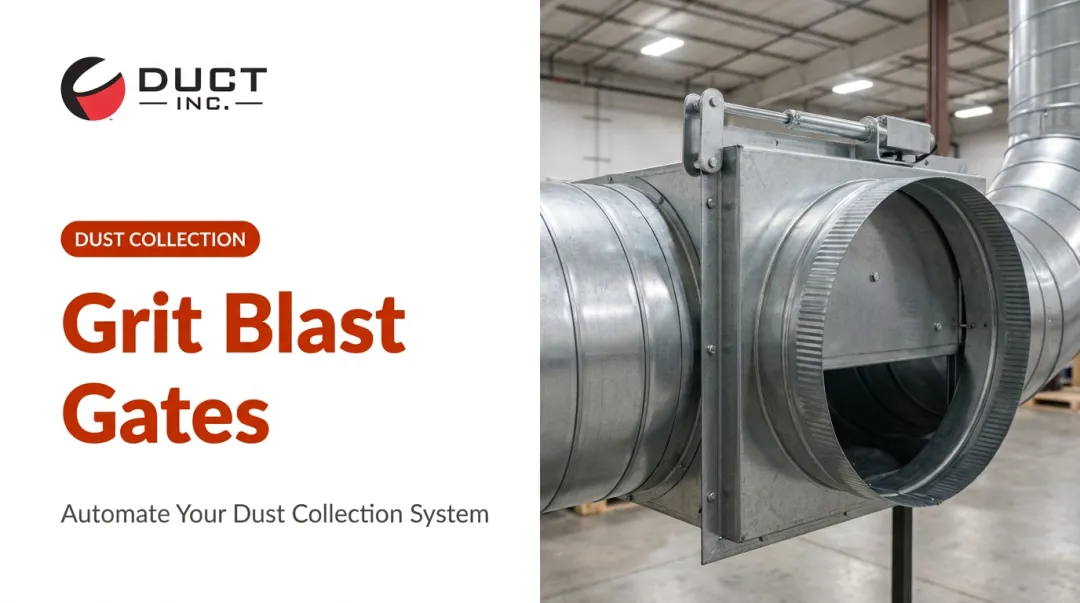
A blast gate is a mechanical valve inserted into a duct run that can be opened or closed to control whether air flows through that branch. It's a foundational component in dust collection, woodworking shops, and industrial ventilation systems.
By isolating inactive branches, a blast gate concentrates the full suction of a dust collector or ventilation fan to whichever machine or area is currently in use. Without gates, a collector splits its suction across every connected branch simultaneously — including the ones doing nothing.
Anatomy of a Blast Gate
That function depends on three core components:
- Outer housing — fits the duct diameter at the branch point
- Sliding blade (the gate) — moves perpendicular to airflow to open or close the duct
- Locking mechanism — holds the blade in position under negative pressure
Where Blast Gates Sit in a Duct System
Blast gates install at branch takeoffs — the points where a secondary duct splits off the main trunk line. This placement is intentional: a gate positioned at the branch lets you isolate that entire run with one motion.
They're distinct from balancing dampers. Dampers are set once to regulate proportional flow across a system. Blast gates are operated repeatedly, going fully open or fully closed each time a machine is switched on or off. Partial closure is generally avoided in dust collection — ACGIH's industrial ventilation manual notes that improper partial closure can cause particulate accumulation or erosion in the duct.
The terms "blast gate," "slide gate," and "duct gate" mean the same thing. "Blaster gate" shows up in informal use, but industrial manufacturers and standards bodies standardize on "blast gate."
How Does a Blast Gate Work?
The operating principle is simple. When the gate blade retracts fully into the housing, the duct is open and air passes freely. When the blade slides across the duct opening, it blocks airflow completely.
The Effect on System Pressure
Closing unused branches does more than just stop air from flowing through them — it changes the pressure dynamics across the entire system. With fewer open paths, the collector's suction forces all available airflow through the active branches, raising velocity in those runs.
This matters for dust transport. NFPA 664 sets 4,000 FPM (roughly 20 m/sec) as the minimum conveying velocity for wood particulate, and automatic dampers in these systems must not reduce main duct velocity below that threshold. As Donaldson Torit explains, if velocity drops too low, dust settles in ducts — creating both clogging risk and combustibility concerns.
Manual vs. Automatic Actuation
| Actuation Type | How It Works | Best For |
|---|---|---|
| Manual | Operator slides the blade by hand | Small shops, low-frequency use, simple systems |
| Automatic | Electric or pneumatic actuator opens/closes the gate when the tool powers on/off | Multi-machine shops, production environments, complex branch layouts |

Gate Sealing
Actuation type is only part of the equation — how well the gate seals determines whether it actually holds system pressure. A poorly fitted or worn blade allows air to bypass the closed gate, reducing effective suction in active branches.
Quality gates are built to tight tolerances that minimize bypass even under sustained negative pressure. Signs that a gate needs replacement include:
- Visible gaps between the blade and housing
- Audible air leakage with the gate closed
- Unexplained pressure drop in active branches
When a gate shows these symptoms, replace it. Adjustment rarely restores a worn gate to spec.
Types of Blast Gates
Slide (Guillotine) Gates
The most common type by far. A flat plate slides perpendicular to airflow within a slotted housing. Simple, one-handed operation, and reliable across thousands of cycles.
Material options:
| Material | Best For |
|---|---|
| Aluminum | Metal duct systems, general industrial use |
| Galvanized steel | Standard industrial configurations |
| Stainless steel (304/316) | Food processing, pharmaceutical, corrosive environments |
| Plastic (PVC/ABS) | Light-duty woodworking only — see compliance note below |
One critical note on plastic gates: NFPA 664 requires metallic ductwork for combustible wood dust systems and prohibits nonconductive materials like PVC. OSHA has cited facilities using plastic duct connections in woodworking applications as a hazard. If your system handles combustible wood dust, metal gates and metal duct are required.
Butterfly (Damper-Style) Gates
A circular disc rotates 90 degrees on a central shaft. More common in HVAC branch control than in dust collection. US Duct explicitly notes that butterfly gates are "not safe for systems with particles going through the duct" — the rotating disc accumulates debris and creates turbulence in dust-laden airstreams. For dust collection, slide gates are the correct choice every time.
That said, if your application involves automated branch control, motorized slide gates offer the best of both worlds: reliable sealing and hands-free operation.
Automatic / Motorized Gates
Automatic gates use electric actuators (typically 24V DC) or pneumatic cylinders controlled by solenoids to open and close based on machine status. Control options include:
- Relay wired to the tool's power circuit
- Current-sensing switch on the power cord
- PLC or Modbus communication for integrated systems
- Wireless tool sensors (on consumer-grade systems like Oneida's iVAC Pro)
Operators never forget to open or close a gate. The correct branch is always active, always at full suction, automatically. For shops with several branch lines or production facilities with many workstations, this removes a consistent source of human error.
How to Choose the Right Blast Gate
Match Gate Diameter to Duct Diameter
This is non-negotiable. A gate that doesn't match the duct's inside diameter creates turbulence at the transition and allows air bypass around the blade. Industrial blast gates are available from 3" up to 30"+ for standard catalog sizes, with larger fabricated options for heavy industrial applications. Duct Incorporated's overall duct system spans 3" to 80"+, with blast gate sizing available across that same broad range.
Measure the duct's inside diameter before ordering. Don't assume the outside diameter matches — wall thickness varies by gauge and material.
Select Material for the Application
| Application | Recommended Material |
|---|---|
| Woodworking / combustible wood dust | Galvanized or aluminum (metal required per NFPA 664) |
| Food processing / pharmaceutical | Stainless steel 304 or 316 |
| General industrial / fume extraction | Galvanized steel or aluminum |
| Corrosive chemical environments | Stainless steel 316 |

Manual vs. Automatic: When to Upgrade
The more branch lines in your system, the higher the chance an operator leaves a gate open when it should be closed. Automatic gates eliminate that variable entirely. Automation makes practical sense when:
- Multiple workstations share a single dust collector
- Production runs continuously with frequent machine switching
- Operator error has caused collector performance problems
Duct Incorporated supplies both manual and automatic slide gate configurations, with design assistance available to help match gate specs to your system.
Installation and Maintenance Tips
Installation
- Position gates at branch takeoffs — as close to where the branch splits from the main trunk as practical
- Orient gates horizontally so the blade slides out horizontally, not downward. A vertically oriented gate can close under gravity or jam open with debris weight
- Seal all connections — air-tight connections at the gate housing prevent bypass leakage. Industry best practice calls for clear silicone caulk applied inside the duct joint; avoid sheet metal screws at connections, as they catch debris and cause clogs. Pop rivets are preferred for rigid connections
- Don't use HVAC duct tape — it fails under the negative pressure and temperature cycling of industrial dust collection; mastic sealant or purpose-made silicone is the right choice
Routine Maintenance
Three things to check regularly:
- Cycle the blade — slide it fully open and fully closed to clear debris from the gate slot
- Inspect the blade — look for warping, cracks, or wear that allows bypass leakage when closed
- Test automatic actuators — verify actuator linkage and wiring connections are operating reliably; limit switches should confirm full open and full close positions
Common Problems and Fixes
| Problem | Likely Cause | Fix |
|---|---|---|
| Gate won't slide smoothly | Debris compaction in slot, or bent blade | Clean the slot; straighten or replace blade |
| Gate doesn't fully seal | Worn blade or misaligned housing | Replace the gate |
| Automatic gate doesn't open | Wiring fault or actuator failure | Check relay/current sensor and actuator connections |
For sticky materials like green wood or sap, self-cleaning gate designs are worth specifying. The blade geometry in these units prevents jamming under those conditions.
Frequently Asked Questions
What is the difference between a blast gate and a damper?
Blast gates operate fully open or fully closed to isolate duct branches entirely. Dampers regulate partial flow for balancing across a system. In dust collection, partial closure drops velocity below the 4,000 FPM minimum needed to keep particulate suspended in the airstream, so blast gates — not dampers — are the correct choice for branch isolation.
What size blast gate do I need?
Match the gate to the inside diameter of your duct. Industrial catalog sizes typically start at 3" and extend to 24"–30" for standard products, with larger fabricated options available. Measure duct inside diameter accurately before ordering — wall thickness means outside diameter won't match the gate sizing.
Can blast gates be used with flex duct?
Yes, with appropriate couplings or clamps. However, rigid duct leading to the gate is strongly preferred — flexible hose causes significant static pressure loss and is only appropriate for short final connections to machines, not for the main run.
How do automatic blast gates know when to open?
Most use a relay or current-sensing switch tied to the tool's power circuit — when the tool runs, the actuator opens the gate; when it stops, the gate closes. More advanced systems use pneumatic cylinders or PLC/Modbus integration for multi-machine coordination.
Are plastic or metal blast gates better for woodworking?
Metal is required for any shop handling combustible wood dust — NFPA 664 prohibits nonconductive duct materials including PVC, making aluminum or galvanized gates the correct choice. Plastic gates are only appropriate for very light-duty setups where combustible dust standards don't apply.
Do blast gates need to be airtight when closed?
A properly fitted gate minimizes bypass significantly, though a perfect seal isn't always achievable. Visible gaps or measurable suction loss through a closed gate indicate a worn blade — replace it promptly, since leakage reduces velocity in the active branch and undermines the whole purpose of the gate.