Two configurations dominate airflow branching in forced-air systems: the duct tee and the duct wye. They look similar on a drawing, but they behave very differently under flow conditions. The wrong choice increases static pressure, wastes fan energy, and creates turbulence that carries straight through to occupied spaces.
This guide breaks down how each fitting performs, where each makes sense, and how to make the call for your specific system.
Key Takeaways
- Wyes branch at ~45°, preserving airflow momentum and reducing pressure drop compared to a 90° tee
- ASHRAE loss coefficient data shows wye branch coefficients up to 73% lower than comparable tees
- Wyes are the preferred choice when velocity exceeds 2,000 FPM, noise control matters, or energy efficiency is a design requirement
- Tees remain practical in space-constrained or low-static residential retrofits
- Balancing dampers are required on every branch run regardless of fitting type
Duct Wye vs. Duct Tee: Quick Comparison
| Attribute | Duct Wye | Duct Tee |
|---|---|---|
| Branch angle | ~45° gradual transition | 90° perpendicular |
| Pressure drop | Lower; loss coefficient ~0.42 at velocity ratio 1.0 | Higher; loss coefficient ~1.56 at velocity ratio 1.0 |
| Turbulence | Reduced recirculation zones | Flow separation at branch inlet |
| Noise | Quieter through-branch flow | More acoustic transmission |
| Space required | Larger footprint, more clearance needed | Compact, fits tight spaces |
| Cost | Slightly higher due to fabrication complexity | Lower cost, simpler to fabricate |
The numbers behind the pressure drop comparison come directly from ASHRAE Fitting Loss Coefficients (Fittings 5-10 and 5-11). At a velocity ratio of 1.0, the round diverging tee carries a branch loss coefficient of 1.56 versus 0.42 for the 45° conical wye — a 73% reduction in the loss coefficient for that geometry and flow condition.

What Is a Duct Wye?
A duct wye is a Y-shaped fitting that introduces a branch duct into a main trunk at approximately 45 degrees. Rather than forcing an abrupt direction change, the angled entry allows airflow to transition gradually. This keeps the boundary layer attached to the duct wall longer and reduces recirculation zones downstream.
The fluid dynamics benefit is measurable. Lower recirculation means a smaller local loss coefficient, which translates directly into preserved velocity pressure and reduced total external static pressure (TESP) on the air handler. Lower TESP moves the fan to a more favorable point on its curve, reducing noise, improving efficiency, and extending service life.
Wye Fitting Variants
Several configurations are available depending on application requirements:
- Standard 45° wye — the most common configuration for supply trunk branching
- Conical wye — ASHRAE Fitting 5-11 specifically describes a conical 45° round diverging wye; ASHRAE's Duct Systems Design Guide notes that 45° entry taps are slightly more efficient than standard conical taps
- Reducing wye — branch diameter differs from the trunk, useful when branch runs serve smaller register boxes
- Long-radius wye — extended geometry for further reduction in separation losses in high-velocity applications
Material options for industrial and commercial systems include galvanized steel (standard), stainless steel 304 or 316 (corrosive or moisture-heavy environments), and aluminum (lightweight or specialty applications). Duct Incorporated manufactures branch fittings in all three materials across diameters from 3" to 80"+, with custom fabrication available for non-standard configurations.
Where Wyes Are Specified
Wyes are the preferred choice in:
- High-pressure main supply trunks where pressure budget is tight
- Noise-sensitive environments: offices, healthcare facilities, recording studios
- Systems designed to ACCA Manual D or SMACNA equivalent-length methodology
- Any branch run where trunk velocity exceeds 2,000 FPM — the threshold above which the ASHRAE Duct Systems Design Guide recommends against straight spin-in tee branches due to elevated loss coefficients

What Is a Duct Tee?
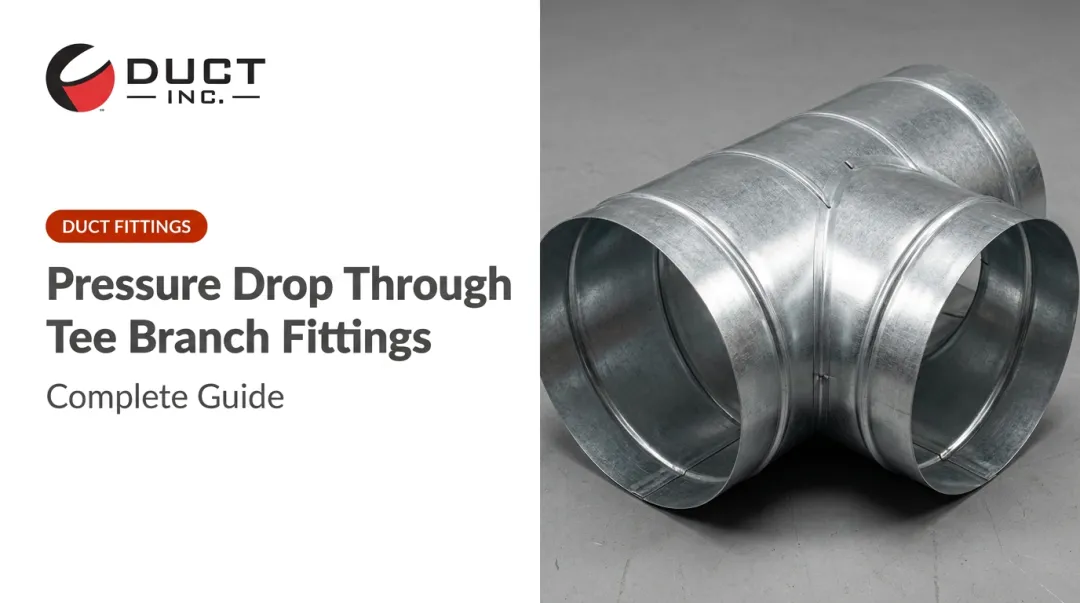
A duct tee connects a branch duct perpendicular to the main trunk at 90 degrees. Airflow traveling down the trunk must make an abrupt directional change to enter the branch, which forces flow separation at the branch inlet edge and creates a turbulent shear layer and recirculation zone inside the opening.
The pressure penalty is real and geometry-dependent. ASHRAE's published loss coefficient data for a round diverging tee (Fitting 5-10) shows branch loss coefficients ranging from 1.03 at a velocity ratio of 0.2 up to 3.40 at a velocity ratio of 2.0. That recirculation zone also acts as an acoustic radiator — turbulence-generated noise transmits easily through sheet metal, which is why tees in high-velocity systems are a common source of supply register noise complaints.
Tee Fitting Variants
- Standard straight tee — 90° branch, widest availability
- Reducing tee — branch smaller than the trunk diameter
- Conical-entry tee — partial sweep at the branch inlet reduces (but does not eliminate) the turbulence penalty
- Bullhead tee — flow enters both branch legs simultaneously; generally avoided in supply systems due to very high loss
Where Tees Are Practical
Tees are a defensible choice when:
- Congested mechanical rooms, attic runs, or tight plenum cavities leave no room for wye geometry
- Static pressure is low enough that branch loss coefficients stay within system design limits — typical of light commercial or short-run industrial layouts
- Existing duct routing makes cutting in a wye impractical without major rework
- Branch runs are short enough that the pressure penalty has minimal accumulated effect at the register
Tees trade aerodynamic efficiency for spatial economy — a defensible decision in constrained conditions, but one that requires balancing dampers on each branch to compensate for the uneven pressure distribution at the takeoff.
Which Configuration Is Better?
Neither fitting is universally superior. The right answer depends on four factors: available installation space, system static pressure budget, noise sensitivity, and whether the system is being designed to a calculation standard or built to convention.
Choose a Wye When:
- Trunk-line velocity exceeds 2,000 FPM (ASHRAE's threshold for avoiding straight spin-in tee branches)
- Acoustic performance is a design requirement — hospitals, open offices, studios
- The system is being designed to ACCA Manual D or SMACNA equivalent-length methodology, where fitting losses directly affect total effective length (TEL) calculations
- Energy efficiency matters: ASHRAE 90.1-2022 Addendum bo identifies reducing duct pressure drop through high-performance fittings as a system-performance option, and AMCA has noted that poor fitting selection is a leading reason systems fail fan power compliance thresholds
Choose a Tee When:
- Space constraints make wye geometry impractical
- The system is low-static residential with short branch runs
- Retrofit conditions prevent wye installation without excessive rework
- The pressure penalty falls within your static pressure budget after calculation
A Practical Scenario
Consider an industrial dust collection retrofit where trunk velocities run 1,800–2,200 FPM across a multi-zone system. If the original design used straight 90° tees at every branch takeoff, the accumulated branch loss coefficients add measurable static pressure — forcing the fan to operate farther up its curve, increasing both energy consumption and noise. Replacing those tees with 45° wye fittings at the high-velocity trunk sections reduces branch loss coefficients substantially, as the ASHRAE data above confirms. The fan settles to a lower operating point, system noise drops, and balancing becomes more predictable.

That pressure-loss improvement is real, but fitting geometry alone won't distribute airflow evenly across branches with different run lengths or resistances.
Don't Skip the Dampers
Wye fittings reduce pressure loss, but they do not self-balance airflow across branch runs with different lengths or resistance. A branch run that is 40 feet long will always see less resistance than one that is 12 feet long, regardless of fitting geometry. Manual or automatic balancing dampers on each branch run are required in both wye and tee systems for precise CFM distribution.
Duct Incorporated manufactures slide gates and diverter valves designed to work alongside their branch fitting line for exactly this purpose — providing system-level flow control across industrial and commercial duct networks.
For engineers and contractors specifying branch fittings for commercial or industrial applications, Duct Incorporated's branch fitting line covers tee and wye configurations in galvanized, stainless steel, and aluminum, with custom fabrication available for non-standard sizes and demanding process environments.
Conclusion
The duct wye is the aerodynamically superior fitting — lower pressure loss, and noticeably quieter branch flow — and that advantage compounds at higher velocities and longer duct runs. The duct tee remains a practical choice when space or budget is the binding constraint, provided the design accounts for the pressure penalty and includes proper balancing.
Getting this decision right at the design or installation stage prevents costly rebalancing, noise remediation, and fan energy waste down the line. Run the numbers using ASHRAE or SMACNA loss coefficients for your specific velocity ratios and check your static pressure budget before finalizing the fitting. If the wye fits within your spatial and cost constraints, it's almost always the better long-term call. Duct Incorporated stocks both wye and tee branch fittings in spiral duct configurations — contact us to discuss sizing and materials for your specific application.
Frequently Asked Questions
When should you use a duct wye vs. a tee?
Use a wye when static pressure efficiency, noise control, or code compliance (ASHRAE 90.1) is a priority — particularly when trunk velocity exceeds 2,000 FPM. Tees are acceptable in tight spaces or lower-velocity systems where pressure drop is less critical. Balancing dampers are required in both configurations.
What is the 2-foot rule for ductwork?
The two-foot rule is an industry rule of thumb recommending at least 24 inches of straight duct before and after fittings, takeoffs, or dampers. According to HVAC Today/National Comfort Institute, it takes roughly 18–24 inches after a directional change for airflow to re-pressurize and normalize, which improves balancing accuracy and static pressure measurement reliability.
Can a duct tee be used instead of a wye at a fan or collector plenum takeoff?
A tee can be used, but it generates more turbulence and pressure drop at the plenum takeoff. A wye is the better choice for preserving airflow momentum and achieving balanced CFM delivery to branch runs — especially on high-velocity industrial supply or exhaust trunks.
Do I still need balancing dampers if I use a wye fitting?
Yes. Wye fittings reduce pressure loss and turbulence but cannot self-balance branches with different lengths or downstream resistance. Dampers on each branch run are still required for precise CFM distribution regardless of fitting geometry.
What materials are duct wye and tee fittings available in?
Common options include galvanized steel (standard commercial and industrial), stainless steel 304 or 316 (corrosive or high-temperature environments), and aluminum (lightweight or specialty applications). Match material to your system's operating conditions: galvanized steel is not recommended above 400°F.