
Getting the sizing right protects both your equipment and your lungs. This guide walks through the math, the practical rules, and the specific diameter recommendations for common woodworking tools.
Key Takeaways
- 4,000 FPM is the minimum transport velocity for wood dust — sizing must maintain this threshold
- 4" diameter is the standard for most stationary woodworking tools; 6" for main trunk lines
- Branch cross-sections must never exceed the trunk cross-section when multiple drops run simultaneously
- Flexible corrugated hose adds roughly 3x the resistance of an equivalent rigid duct run
- Size to the tool port first, then work backward to collector capacity
What Are Dust Collection Hoses and Why Size Matters
Dust collection hoses are the flexible or semi-rigid conduits that carry dust-laden air from machine ports to a central collector. "Size" always refers to inner diameter (ID) — the primary variable controlling how much air the hose can carry.
Common Dust Collection Hose Sizes
The standard diameters span a wide range, each suited to different tools and system positions:
| Diameter | Typical Application | Cross-Sectional Area | CFM at 4,000 FPM |
|---|---|---|---|
| 1.5"–2" | Handheld routers, over-blade guards | 3.14 sq in (2") | ~87 CFM |
| 2.5" | Shop vacuums, sanders, small routers | 4.91 sq in | ~136 CFM |
| 4" | Most stationary tools (table saw, jointer, planer) | 12.57 sq in | ~349 CFM |
| 6" | Main trunk lines, high-capacity collectors | 28.27 sq in | ~785 CFM |

Area values calculated using A = π × r²; CFM estimates based on WOOD Magazine's 4,000 FPM formula: area in square inches × 28.
A 4" hose carries 4x the cross-sectional area of a 2" hose, not double. Moving from 4" to 6" adds another 2.25x in area. Undersize by just one step and you cut available airflow by more than half — which is why diameter choices have consequences that run far beyond what the numbers first suggest.
Flexible Hose vs. Rigid Duct
Once diameter is set, hose material determines how much of that capacity actually reaches the tool. Corrugated flexible hose creates turbulence at every ridge along its inner wall, and the friction penalty is significant:
- 4" flex hose: 0.280 in WC of static pressure loss per foot at 4,000 FPM
- 6" flex hose: 0.180 in WC per foot at 4,000 FPM
- Count each foot of flex hose as 3 feet of equivalent straight rigid pipe when calculating system resistance
Flexible hose is appropriate for tool connections and short drops. For any run that stays in one place, smooth-wall rigid duct — galvanized steel, PVC, or spiral duct — preserves velocity and leaves more of the collector's static pressure budget for actual work.
Key Factors for Choosing the Right Dust Collection Hose Size
Hose sizing depends on collector capacity, tool dust output, and system layout working together. Four variables drive the decision.
CFM Requirements and Airflow Velocity
Two numbers govern dust collection performance:
- CFM (cubic feet per minute): volume of air moved
- FPM (feet per minute): transport velocity
WOOD Magazine and the ACGIH industrial ventilation manual both cite 4,000 FPM as the minimum conveying velocity for wood dust. Below this threshold, particles begin settling inside the duct — creating blockages and fire risk.
To find the minimum hose diameter for a given application: take the required CFM, divide by 4,000 FPM, convert to square inches, then work back to diameter. WOOD Magazine's shortcut: area (sq in) = CFM ÷ 28.
Narrowing the hose to "increase suction" actually hurts collection. Oneida Air's data shows a 2 HP collector delivers 800 CFM through 6" pipe but only ~400 CFM through 4" pipe, even though the 4" system reads higher static pressure. Higher restriction does not mean more air moved.
Tool Port Size and Collector Capacity
The tool's existing dust port sets your starting diameter at the machine:
- SawStop cabinet saws: 4" port, minimum 350 CFM required
- Powermatic 20" planers: 4" port, 900 CFM minimum required
- Powermatic jointers: 4" port
Running a larger hose into a smaller port creates a bottleneck at the machine, not the hose. Match the hose diameter to the tool port, then verify that the upstream duct maintains target velocity at the required CFM.
On collector capacity, two practical rules apply:
- Don't exceed the collector's inlet diameter with the main duct
- Verify actual CFM output against the fan curve, not just horsepower rating
Many generic 1.5 HP collectors won't sustain sufficient airflow through a 6" port — fan curves tell the real story.
Main Trunk vs. Branch Line Sizing
The trunk-and-branch principle: the main duct must have enough cross-sectional area to carry all simultaneously open branches without dropping below 4,000 FPM.
A quick example using the area values above:
- 6" trunk = 28.27 sq in
- One 4" branch (12.57 sq in) + one 5" branch (19.63 sq in) = 32.20 sq in → exceeds trunk capacity
- One 4" branch + one 4" branch = 25.14 sq in → fits within a 6" trunk

When adding branches, use 45° wye fittings rather than perpendicular tees. Oneida's pressure data shows a 6" 45° wye adds 0.329 in WC of resistance compared to 0.564 in WC for a 90° elbow, roughly 40% less fitting loss.
Hose Length and Friction Loss
Every additional foot of corrugated hose consumes static pressure. At 4,000 FPM through 4" flex hose, you're spending 0.280 in WC per foot — before accounting for any fittings.
For runs beyond 6–8 feet:
- Transition to smooth-wall rigid duct
- Replace sharp 90° elbows with two 45° bends in sequence
Keep fitting losses in perspective: a 4" 90° elbow adds the equivalent of 6 feet of straight pipe, while a 30° wye adds only 3 feet equivalent.
Recommended Dust Collection Hose Sizes by Tool Type
Table Saw
Cabinet saws: 4" at the cabinet port is standard. SawStop's Industrial Cabinet Saw uses a 4" dust port requiring at least 350 CFM. If an over-blade guard is also connected, size it at 2"–2.5" and verify the combined branch areas don't exceed your trunk.
Contractor saws: Some models (including SawStop's contractor version) include both 2.5" and 4" ports on the dust collection panel — connect both where possible.
Planer and Jointer
Both generate high chip volumes and warrant 4" minimum. The Powermatic 20" planer has a 4" port but requires 900 CFM — meaning the upstream duct should be 6" to carry that volume at transport velocity. Oneida's design guidance for a 20" planer recommends 6" pipe for the same reason.
Jointers (Powermatic PJ-882 and comparable machines) use 4" ports. Note that dryer vent hose is explicitly not acceptable per the manufacturer. Use proper dust collection hose or rigid duct.
Router Table and Handheld Routers
- Router table: 2.5" at the fence/bit port; transition to a 4" branch where it joins the main trunk
- Handheld routers: Bosch's router dust attachment connects to 35mm, 1-1/4", and 1-1/2" vacuum hoses — these tools belong on a shop vacuum or dust extractor, not a central collector
Band Saw and Sanders
Band saws: The Powermatic 14" model uses a 4" port requiring 350 CFM minimum. Larger 18"–24" models use two 4" ports and require 600 CFM minimum extraction. A properly sealed enclosure concentrates airflow more effectively than hose diameter alone.
Sanders:
- Drum sanders (JET JWDS-1020): 4" port, high-volume collector required
- Belt/disc sanders (JET JSG-6DC): 4" hose to the dust port
- Orbital and random-orbit sanders: Mirka lists a 1" vacuum hose connection; Festool uses 27/32mm hose — these need a shop vacuum or dust extractor, not a low-static-pressure dust collector
How Duct Incorporated Can Help
Selecting the right hose diameter is only part of the equation. The duct material, wall construction, and fitting geometry all affect whether a system actually delivers the CFM your tools require.
Duct Incorporated manufactures industrial-grade spiral duct and fittings built for demanding dust collection environments. The standard catalog covers spiral pipe from 3" through 16" (and up to 80"+ for larger industrial systems), with 4" and 6" available in 22-gauge galvanized, galvaneal, stainless steel 304/316, or aluminum.
The smooth interior of spiral duct eliminates the corrugation drag that makes flexible hose so costly in long runs — a meaningful efficiency gain in any trunk-and-branch layout.
For building out a trunk-and-branch layout, the product line includes:
- Branch fittings (wyes and laterals) that connect to the trunk cleanly, with minimal pressure loss
- Reducers and transitions for stepping down from a 6" trunk to a 4" tool drop
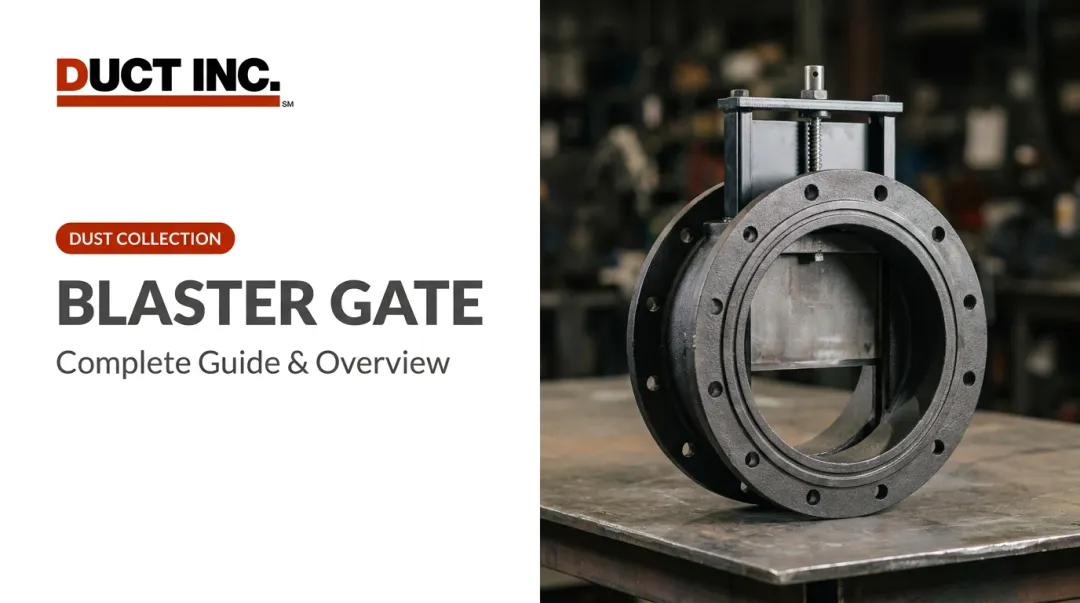
- Slide gates and blast gate dampers in standard catalog sizes for controlling individual machine drops
- Elbows and bends sized to minimize resistance — especially important when replacing sharp 90° turns
- Clamps, hangers, and support hardware compatible across the full duct range

Duct Incorporated also offers sizing worksheets and technical resources at ductincorporated.com, with pricing available on request. Whether you're adding a single machine drop or redesigning a full shop layout, the team can help match components to your system's specific CFM and velocity requirements.
Conclusion
The decision framework reduces to four steps:
- Start with the tool's port size
- Verify the collector's rated CFM against the system's actual duct diameter
- Calculate the minimum diameter needed to maintain 4,000 FPM transport velocity
- Apply the trunk-area rule whenever you split the line
Default to rigid smooth-wall duct for any run that exceeds 6 feet. Use flex hose only at the final connection to the tool, and count it at 3x the equivalent length of rigid pipe when budgeting static pressure.
Dust collection system performance should be revisited whenever a new machine joins the shop. A balanced three-tool system can become an underperforming network the moment a fourth machine is added without recalculating branch and trunk sizing.
Frequently Asked Questions
What size pipe should I use for dust collection?
It depends on your collector's CFM rating and the tools being served. For most stationary woodworking machines, 4" is standard at the tool port. Main trunk lines serving multiple machines typically need 6". Small portable tools like routers and orbital sanders work best with 2.5" hose connected to a shop vacuum rather than a central collector.
What is the best hose for a dust collector?
Smooth-wall rigid duct — galvanized steel, spiral duct, or PVC — creates far less friction loss than corrugated flex hose, making it the right choice for any run longer than 6 feet. Use flexible hose only for short final connections at the tool port.
Is 4-inch or 6-inch dust collection better?
The right choice depends on system scale. A 4" drop is appropriate for individual tool connections and smaller collectors. A 6" main trunk line is needed when multiple machines run simultaneously. Using 6" throughout a small single-tool setup can actually drop velocity below the transport threshold and hurt performance.
How does hose length affect dust collection performance?
Longer hoses add friction resistance and reduce CFM at the tool. Flexible corrugated hose worsens this effect — Air Handling Systems recommends treating each foot of flex as 3 feet of equivalent rigid pipe. For long runs, transition to rigid duct and use sweeping bends rather than sharp 90° elbows to minimize resistance.
Can I use flexible hose for my entire dust collection system?
No. Corrugated flex hose creates enough friction to measurably reduce airflow over any substantial run. Reserve flexible hose for the final 2–3 foot connection between the rigid duct line and the tool port. For everything else, smooth-wall rigid duct preserves the velocity and CFM your system needs.
What is the difference between a dust collector hose and a shop vac hose?
Dust collector hoses are larger in diameter (typically 4"–6") and designed for high-volume, lower-static-pressure systems. Shop vac hoses are smaller (1.5"–2.5") but run at much higher static suction — making them better for small-port tools like handheld routers and sanders, while central collectors are the right fit for high-CFM machines like planers and drum sanders.